


.webp)
When you're an early-stage SaaS company with a genuinely innovative product, the irony is brutal: the companies who need you most have no idea you exist.
Awaio had built the unified workplace platform that hybrid enterprises actually wanted—one app to replace the chaotic mess of parking tools, desk booking systems, room schedulers, and access management software. But in January 2025, they were ranking for exactly 88 keywords, driving 300 organic visitors per month, and generating no inbound demos from search.
This is the story of how we built their organic channel from scratch. In 11 months, we took them from no visibility to 171 sales-qualified leads, with enterprise buyers finding them through high-intent searches. The goal wasn't "let's increase traffic". No six-month technical audits. Just ruthless focus on the searches that actually convert.
The Hybrid Work Problem Nobody Was Solving Right
Here's what hybrid work actually looks like at most companies: Your facilities team is juggling seven different platforms. One vendor for parking. Another for desk booking. A third for meeting rooms. Something else for access control. Different tools for visitor management, locker assignments, and god knows what else.
Each one requires admin overhead, separate training, and its own login. Data lives in silos. Employees download five apps just to show up to the office.
Awaio saw this mess and built the solution: one unified platform connecting every piece of the workplace experience. From the moment employees leave home to the space they sit in, Awaio handles commuting, parking, desks, rooms, lockers, access, and shared resources in a single, frictionless interface.
It's the kind of product that makes facilities managers and IT teams exhale with relief when they see it.
But in January 2025, none of their ideal buyers were finding it. Despite targeting enterprise companies across EMEA and the US, Awaio was functionally invisible:
- 300 monthly organic visitors (mostly branded searches)
- 88 ranking keywords total
- 0 organic conversions
- Zero visibility for product-category searches
The product was ready. The market needed it. The connection just didn't exist.
Great Product, Zero Inbound
Awaio's challenge wasn't complicated. They had three problems that fed into each other:
1. No way to reach ready-to-buy customers
Companies were actively searching for workplace management solutions. Typing "desk booking software" into search engines. Comparing "Skedda alternatives." Looking for "office space optimization" best practices. Awaio had exactly what they needed, but wasn't showing up in any of these searches.
2. No in-house SEO expertise (and no bandwidth to build it)
Like most early-stage companies, Awaio's team was stretched thin. Building an internal SEO function would mean hiring, training, and months of ramp-up time they didn't have. They needed results now, not eventually.
3. Previous experiments didn't meet expectations
They'd tried ABM on LinkedIn, paid campaigns across Meta and Google. Minimal results. The traditional playbook for enterprise SaaS is expensive, slow, and ultimately not delivering the inbound pipeline they needed.
This is the trap early-stage SaaS companies find themselves in: You can't afford to build the expertise internally, but you also can't afford to stay invisible. Meanwhile, your competitors (or just older, better-funded alternatives) are capturing all the demand you should be getting.
How We Built Awaio's Inbound Engine from Zero
Our approach for Awaio was simple in theory: identify the exact searches their buyers use when they're ready to evaluate solutions, create content that shows up for those searches, and build enough authority to rank fast.
No six-month technical audit. No "brand awareness" content that never converts. We were laser focus on the bottom of the funnel where purchase decisions happen.
Here's how we executed:
1. Skip the Technical Theater: Focus on What Matters
Here's a dirty secret about SEO agencies: many will spend months "fixing" technical issues on sites that don't actually have meaningful technical problems. It's easy to bill for, looks sophisticated, and delays the hard work of creating content that converts.
Awaio's site was young and clean. No reason at all to manufacture a technical audit that justified months of billable work. Instead, we did a quick assessment, confirmed there were no critical blockers, and got straight to work on what would actually drive results: high-intent content and authoritative backlinks.
This isn't laziness. It's ruthless prioritization. For early-stage companies, speed to results matters more than perfect technical polish.
2. Target the Searches That Signal "I'm Evaluating Solutions"
We mapped out every search query that indicated someone was actively evaluating workplace management solutions. These weren't informational searches. These were buying searches.
Bottom-funnel comparison content:
We prioritized pages around searches with strong buying intent. For Awaio, these for "best desk sharing software," "Skedda alternatives," and "best office space management software." These are the searches that happen when someone's already convinced they need a solution and is comparing options. You show up here, you're in the consideration set.
Middle-funnel solution searches:
Once we had covered the most important searches in the bottom-funnel, we added content targeting "how to optimize office space" and "office space planning guidelines." These catch buyers earlier in their research, positioning Awaio as the trusted expert before they even start comparing specific tools.
Pain-point driven topics:
Every piece addressed the specific frustrations we knew Awaio's buyers experienced:
- The admin nightmare of hardware-dependent solutions
- Managing five different tools just to run an office
- Scattered data making space utilization decisions impossible
- The hidden costs of point solutions that don't talk to each other
We avoided generic explainers like "what is office space management." That content might get traffic, but it doesn't get demos. We focused exclusively on searches that indicated active evaluation or immediate pain.
3. Build Domain Authority Fast (When You're Starting from 15)
Content alone doesn't rank when your domain authority is 15 and you're competing against established players. We needed to build trust signals quickly.
We ran targeted link building campaigns focused entirely on quality over quantity:
- Secured placements in industry-relevant publications with DA 40+ and 100k-1M monthly traffic
- Got Awaio mentioned in third-party workplace management and hybrid work roundups
- Prioritized relevance: every backlink came from content actually related to workplace operations, facility management, or HR tech
In 11 months, we took Awaio from DA 15 to DA 23, grew their backlink profile from 276 to 468 links, and expanded their referring domains from 71 to 207.
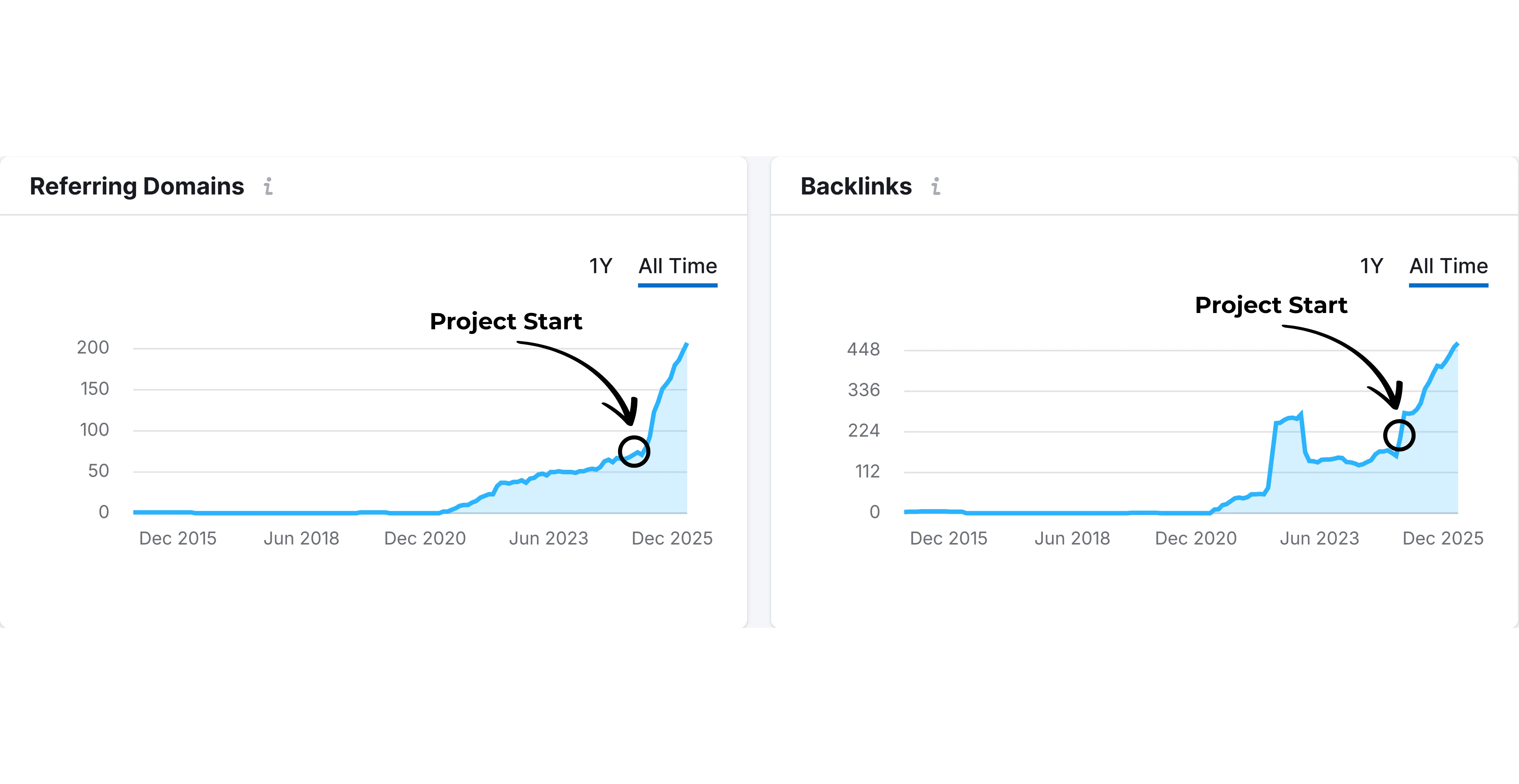
The goal wasn't to hit arbitrary link targets. It was to build enough authority that search engines would trust Awaio's content when someone searched for workplace management solutions.
From No Organic Inbound to 30 Demos Per Month
Here's what 11 months of execution delivered:
Search visibility:
- Monthly organic traffic: 300 → 2,400 (700% increase)
- Ranking keywords: 88 → 1,000 (1,036% increase)
- Top-10 rankings: 0 → 200
- Domain Authority: 15 → 23
Business impact:
- Monthly organic conversions: 0 → 30
- Total SQLs in 11 months: 171 (demos + contact requests)
.webp)
.webp)
.webp)
The numbers are impressive, but here's what actually mattered to Awaio: they went from completely invisible to having a consistent, predictable pipeline of inbound demos from companies actively looking for workplace management solutions.
As Niclas Eglinger, Awaio's Co-founder & COO, put it:
"We knew SEO/GEO usually takes time, so we weren't expecting quick results. But Exceed surprised us. In less than a month, we've booked 6+ demos from both Google and ChatGPT Search—and now we're seeing demand from completely new markets."
That speed is unusual, but it's what happens when you focus exclusively on high-intent searches from day one. No six months of "building foundation." Just immediate focus on the searches that drive demos.
Awaio's sales team went from having to create every opportunity through outbound to fielding qualified inbound leads who already understood the product category and were actively evaluating solutions.
What Made This Work for an Early-Stage Company
Awaio's results came from making the right strategic choices for their stage and market position:
1. We Started Where Purchase Decisions Actually Happen
Most early-stage companies make the mistake of trying to "build awareness" through educational content. We did the opposite: we started at the bottom of the funnel where people were actively comparing solutions and making buying decisions.
When someone searches "Skedda alternatives," they're not researching the concept of desk booking—they're already using a competitor and looking to switch. That's when Awaio needs to show up.
2. We Skipped the Vanity Work
Awaio's site didn't need months of technical SEO work. It was clean, fast, and functional. We could have manufactured a technical audit to justify more billable hours. Instead, we acknowledged there were no critical blockers and got straight to creating content that converts.
For early-stage companies, speed matters more than perfection. Getting your first demos from organic search in month one beats having a perfect technical foundation in month six.
3. We Matched Content to Real Buyer Pain Points
Every piece of content addressed something we knew Awaio's buyers were struggling with:
- Juggling multiple disconnected tools
- Hardware dependency driving up costs
- Admin overload from managing separate systems
- Lack of unified data for space optimization
This wasn't guesswork. We talked to their team, understood their competitive positioning, and mirrored the language their prospects actually used.
4. We Built Authority Deliberately, Not Desperately
With a starting DA of 15, we couldn't compete for high-volume keywords against established players. So we focused on:
- Industry-relevant backlinks (not any link we could get)
- Publications their actual buyers read
- Building just enough authority to rank for lower-competition, high-intent searches
This let us compete effectively even as the newest player in the space.
5. We Acted as an Extension of Their Team
Niclas called out our "level of ambition and client-first mindset." We weren't treating Awaio like another retainer. We were invested in solving their specific problem: getting inbound demos from qualified enterprise prospects.
That meant Slack availability, transparent reporting, and treating every keyword decision like it was our own pipeline at stake.
What Early-Stage SaaS Companies Can Learn from Awaio
If you're running marketing at an early-stage B2B SaaS company, here's what Awaio's experience should tell you:
Start at the bottom of the funnel, not the top.
Don't waste your limited resources on "thought leadership" and educational content when you have zero visibility. Target the searches people use when they're actively evaluating solutions. Capture that demand first, then expand to earlier-stage content once you have momentum.
Speed to first results matters more than perfect execution.
You don't have the luxury of six-month setup phases. Awaio started seeing demos in less than a month because we focused on what would drive results immediately, not what would look impressive in an audit.
Don't build expertise you can't afford.
Hiring an internal SEO team when you're early-stage means months of recruiting, ramp-up time, and experimentation while your competitors capture all the inbound demand. Partner with people who've already made the mistakes and know what works.
Authority building is non-negotiable (but focus matters).
You can't rank with a DA of 15 and no backlinks. But you also don't need 1,000 random links. Awaio got results by strategically building authority from industry-relevant sources, not chasing quantity.
Match content to actual buyer pain, not your product positioning.
Awaio's buyers weren't searching for "unified workplace platforms." They were searching for solutions to specific problems: too many tools, hardware dependency, admin overload. We met them where they were, not where Awaio wanted them to be.
Measure what actually matters.
Organic traffic is a vanity metric. Keyword rankings are a vanity metric. For Awaio, the only metric that mattered was demos booked. Everything else was just a leading indicator.
The Takeaway: Building Inbound Demand When You're Starting from Zero
Awaio's story isn't about going from good to great. It's about going from invisible to viable—from zero organic demos to a consistent pipeline of qualified enterprise leads finding them through search.
If you're an early-stage B2B SaaS company with a genuinely innovative product, the path forward is clear: stop trying to build awareness and start capturing demand. Your buyers are out there searching. You just need to show up where they're looking.
Ready to build your inbound engine? Let's talk.
