
.webp)

I've spent the last 18 months analyzing SEO performance across 50+ B2B SaaS companies. Not as an observer—as the person responsible for driving their organic pipeline.
Here's what I've learned: most B2B SaaS SEO advice is technically correct but strategically backwards.
The standard playbook tells you to start with technical audits, build topical authority through TOFU content, and gradually work your way down to conversion-focused pages. That approach takes 6-12 months to generate your first organic demo. You probably can’t wait a year until you start seeing results, which I totally get.
I'm actually going to show you the opposite: how to generate SQLs in month one by starting where purchase decisions actually happen.
This is what separates old-school SEO that chases vanity metrics (traffic) with revenue generating SEO, and these B2B SaaS agencies have cracked that code.
So let’s start..
The conversion rate problem nobody talks about
When I audit a B2B SaaS company's organic strategy, I see the same pattern:
- 15,000+ monthly organic visitors
- 15 form fills
- 2 actual SQLs
- 1 closed deal
That's a 0.013% SQL conversion rate from organic traffic. Out of 15,000 visitors, only 2 are actually qualified.
The problem isn't traffic volume. It's that 95% of their organic visitors are completely wrong-fit: students researching concepts, job seekers checking out the company, generic researchers, or early-stage founders who can't afford the product.
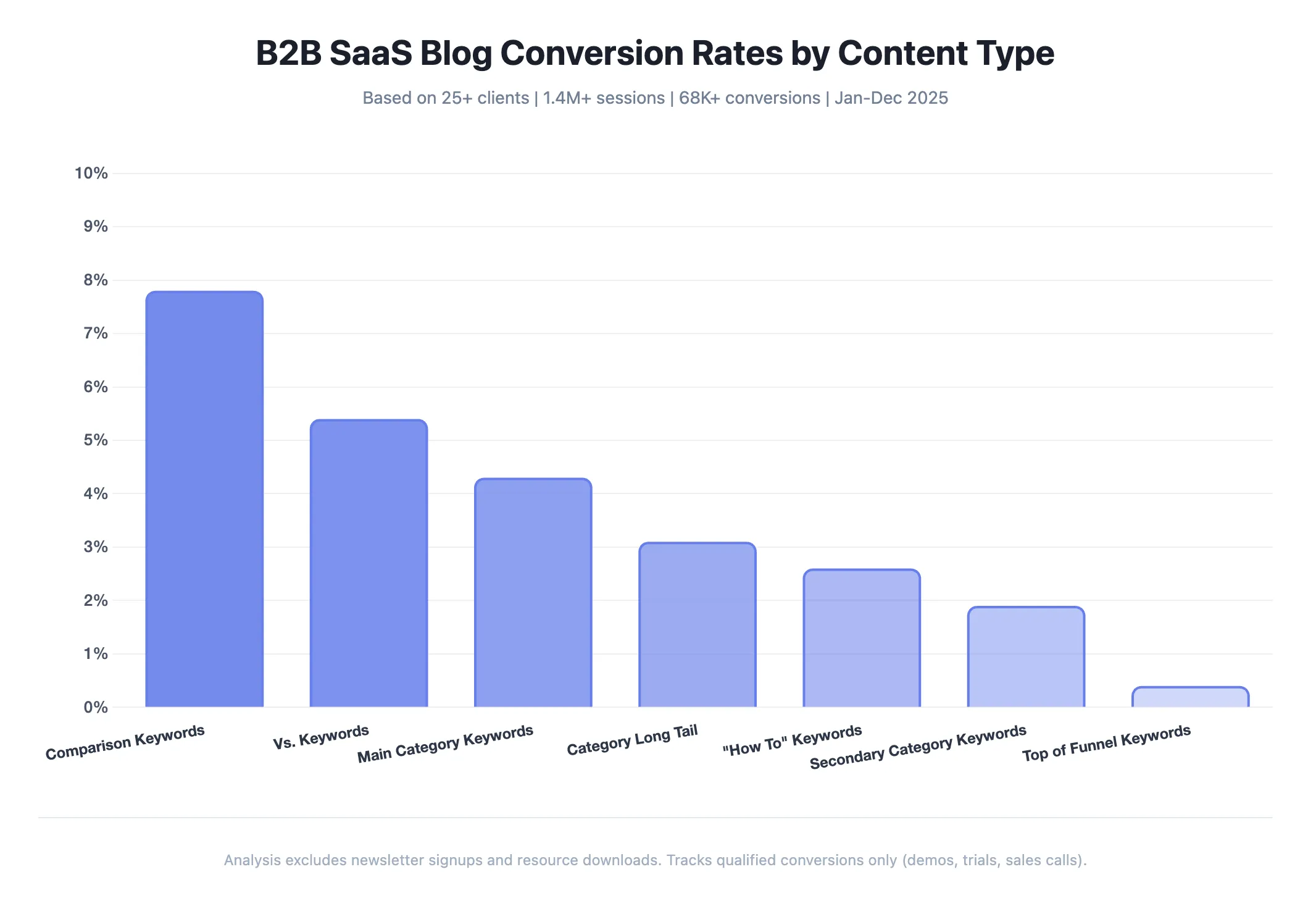
Here's what changed our entire approach: We analyzed conversion data across 25 B2B SaaS clients and found that certain keyword types converted at 15-20x the rate of others.
- A visitor from "Project management best practices" converts at 0.1%.
- A visitor from "Asana alternative for enterprise" converts at 7.8%.
Same product. Same website. 17x difference in conversion rate.
That single insight changed everything. Stop chasing traffic. Start chasing the right traffic.
The bottom-up SEO strategy (that generated 171 SQLs in 11 months for Awaio)
We worked with Awaio, an established workplace management platform. When they came to us:
- 30 monthly organic visitors (mostly branded)
- 88 ranking keywords total
- 0 organic demos (this is the important one, really, you can ignore the rest)
- Domain Authority of 15
If you want to dive deeper into the results, check out this Awaio case study.

This is what the old-school SEO playbook would tell them:
- Technical audit phase (3-6 months): Perfect every technical detail before publishing a single piece of content
- Educational content phase (6-12 months): Build "topical authority" with beginner guides that attract researchers, not buyers
- On-page optimization phase (ongoing): Methodically optimize meta descriptions and header tags across every page
- Commercial content phase (month 12-18+): Start creating comparison pages and adding demo CTAs
- Results (hopefully): You've got traffic, but it's not converting—because you spent a year attracting the wrong audience
We did the opposite, obviously…
#1 We started with customer intelligence

First, we sat down with their sales team and founders. Not a generic "tell us about your customers" conversation—we had specific questions:
- Which deals closed the fastest? What did those buyers search for before finding you?
- What exact phrases do prospects use in discovery calls to describe their problems?
- Which competitors come up most often, and why do you win or lose against them?
- What makes someone choose you over building an in-house solution?
Questions we ask:

If you want to run through these questions with your team → you can access the doc and create your own copy.
These conversations revealed something critical: Awaio's best customers weren't searching for "workplace management" or "office optimization." They were searching for very specific solutions like "conference room booking software" and "[Competitor] alternative for enterprise."
And this is one of the biggest blindspot for marketing teams, not talking to sales.
#2 Then we did keyword research based on the insights from the interview
Armed with these insights, we mapped out the exact searches their buyers make when they're ready to evaluate solutions. Not high-volume category keywords. Not educational queries. Just the bottom-funnel searches that signal "I'm comparing options right now."
We found:
- Category pages like "best meeting room booking software" (high intent, achievable competition)
- Competitor alternatives like "Skedda alternative for enterprise" (highest intent, lower competition)
- Use-case specific searches like "workplace management software for hybrid teams"
Check the original keyword research doc below:

#3 Then we created content using real buyer language
Here's where most companies screw up: they write content based on their internal brainstorming, not how real buyers actually talk.
We analyzed the SERPs to see what was already ranking. Then we went deeper—reading G2 reviews, Reddit threads, and industry forums to understand:
- The exact language people use to describe their problems
- The specific pain points that make them search for solutions
- The "why now" that triggers them to start evaluating software
For example, we didn't write "Awaio helps optimize space utilization." We wrote "Stop juggling five different apps just to book a desk"—because that's what we heard in reviews and Reddit threads.
#4 The results came fast
Within the first month, they had pages ranking for "best meeting room booking software" and "best conference room technology."
By month two, they published four competitor comparison pages and booked their first demo from organic search.
By month three, they were ranking for broader category terms like "best workplace management software for enterprises."
After 11 months:
- 2,400 monthly organic visitors (from 300)
- 1,000 ranking keywords (from 88)
- 171 SQLs from organic (demos + contact requests)
- 30 demos per month consistently

We’ve followed this process systematically, and here's why you should do the same if you want SEO to generate revenue:
1. BOFU keywords have buyer intent built in
When someone searches "What is hot desking?" they might be:
- A student writing a paper
- A freelancer researching the market
- A consultant building a deck
- An actual buyer (maybe 5% of searchers), although, if you’re a buyer, chances are you already know what hot desking is…
When someone searches "Skedda alternative for enterprise" they are:
- Currently using a competitor
- Actively evaluating alternatives
- Have budget (they're already paying for a solution)
- In a buying cycle right now
The second search has 95% lower volume. But 100% higher intent.
2. Comparison content ranks faster with lower authority
Here's something most SEOs won't tell you: comparison keywords are easier to rank for than product category keywords.
"Project management software" → You're competing against Monday.com (DA 82), Asana (DA 80), ClickUp (DA 71)
"Asana alternative for startups" → You're competing against random listicles and aggregator sites (DA 30-50)
Awaio started with DA 15. They couldn't compete for "workplace management software"
But they absolutely could compete for "Skedda alternatives"—and that's exactly where their buyers were searching.
3. You need fewer backlinks to see results
When you target high-volume category keywords, you need 50+ high-authority backlinks to break into the top 10.
When you target specific comparison keywords, you need 5-10 relevant backlinks.
For Awaio, we grew their backlink profile from 276 to 468 links in 11 months. That's 17 new links per month—completely achievable for an early-stage company if that’s you.
Those 192 new links generated 171 SQLs. That's one SQL per link. Show me another marketing channel with that ROI.
The three-tier keyword strategy that actually converts
After analyzing conversion data across 200+ B2B SaaS companies, we've identified three keyword tiers that consistently drive SQLs:
Tier 1: Competitor Alternative Keywords (Highest Intent)

Format: "[Competitor] alternative for [specific use case]" or just “[Competitor] alternative”
Examples:
- "Salesforce alternative for startups"
- "HubSpot alternative for agencies"
- "Asana alternative for enterprise"
- “Asana vs Monday vs (your tool)”
Why they convert: The searcher is already paying for a solution, has budget approved, understands the category, and is actively evaluating alternatives. These are bottom-of-funnel searches with credit cards ready.
Tier 2: Solution-Specific Keywords and Main Category Keywords (High Intent)

Format: "[Solution category] for [specific audience/use case]"
Examples:
- "CRM for real estate teams"
- "Project management software with time tracking"
- "Marketing automation software"
Why they convert: The searcher knows what solution type they need and has specific requirements. They're comparing options and building a shortlist.
Tier 3: Problem-Aware Keywords (Medium Intent)

Format: "How to [solve specific problem]" or "[Problem] solution"
Examples:
- "How to automate customer onboarding"
- "Reduce customer churn software"
- "Streamline sales follow-up process"
Why they convert: The searcher has a specific problem and is researching solutions. They may not know your category exists yet, but they're ready to solve the problem.
What we don't target: Generic category keywords ("what is CRM"), informational queries that attract wrong-fit traffic ("CRM best practices"), or top-of-funnel content that generates email subscribers who never convert.
The AI Search advantage (That's Generating 40% of Our Client Demos)
Here's something most B2B SaaS companies haven't noticed: ChatGPT is now sending 8-9x more referral traffic than Perplexity, and those visitors convert 3-5x better than traditional Google traffic.
Why? Because the AI has already done the research, comparison, and initial qualification. When someone clicks through from a ChatGPT recommendation, they're not starting their research—they're validating a recommendation they've already received.
What works for AI citations:
- Answer-first content structure: Put the complete answer in the first 60-80 words. AI systems extract and cite content they can easily parse.
- Comparison tables: Every competitor comparison page needs a feature-by-feature table at the top. 43.8% of AI citations come from comparison content.
- Honest recommendations: When you say "Competitor X is better if you need Y," AI systems trust you more and cite you more frequently. We've seen this pattern across thousands of queries.
- Recent content: 79.1% of AI-cited content was updated in 2025. If your comparison page is from 2023, it's invisible to AI search.
What most B2B SaaS companies get wrong about authority building
The standard advice is usually to "Build topical authority by publishing comprehensive content on every topic in your category."
The reality is that Google and AI systems don't care about your “What is X?” content, because they can generate that information without using your content.
You should focus on buying decision authority.
Not so long ago, I stumbled upon a study done by Ahrefs that sparked som noise in the industry
They analyzed 26,283 AI sourced URLs - and this is what I took from it:
Authority signals that actually matter:
- Brand mentions in industry publications (not necessarily linked)
- Customer reviews on G2, Capterra, TrustRadius
- Case studies with measurable results
- Product integrations and marketplace listings
- Founder thought leadership on LinkedIn
Authority signals that barely matter:
- Publishing 100 blog posts about tangentially related topics
- Targeting every possible keyword in your space
- Creating "ultimate guides"
When we took Awaio from 30 to 2.4K+ monthly traffic, we didn't do it by publishing 200 blog posts. We did it by:
- Getting mentioned in 15 industry publications (not necessarily with links)
- Securing 5 strategic backlinks from high-authority workplace management sites
- Building out their G2 profile with customer reviews
- Focusing on content quality rather than quality. When we created BOFU articles, we didn’t jump to Google or ChatGPT to do ICP research. Instead, we interviewed Awaios internal team: the founder, CTO, Sales rep etc.
Strategic authority building, not comprehensive authority building.
The content that we see converts
Content that drives SQLs:
- Competitor comparison pages (Our #1 SQL driver across all clients)
- Honest feature-by-feature comparison
- Clear use case recommendations ("Choose them if..., choose us if...")
- Transparent pricing comparison
- Migration guide if they want to switch
- Alternative and category pages ("Top 10 [Competitor] Alternatives", “5 Best [category] software for small businesses”)
- Your product positioned among alternatives
- Honest assessment of each option
- Specific recommendations by use case
- Interactive selection tool
- Use case pages ("[Your Category] for [Specific Industry]")
- Industry-specific pain points
- How your product solves them
- Industry-specific case studies
- ROI calculator tailored to that industry
- Integration pages
- Detailed setup guides
- Common use cases for the integration
- Troubleshooting FAQ
- Customer examples using the integration
Content that generates traffic but rarely converts:
- Generic "What is..." definitions ("What is project management")
- Beginner-level educational content ("Project management 101")
- Generic best practice articles ("10 tips for better team collaboration")
I'm not saying never create this content. I'm saying if you're an early-stage B2B SaaS company with limited resources, start with the content that converts first.
The technical SEO myth (and the rabbit hole)
Most SEO agencies will sell you a 3-month technical audit. Here's what I've learned auditing 200+ B2B SaaS websites:
Technical issues that actually block rankings:
- Broken robots.txt blocking important pages
- HTTPS issues or mixed content warnings
- Completely broken mobile experience
- Pages taking 10+ seconds to load
- No XML sitemap or schema markup
Technical issues that agencies obsess over but barely matter:
- PageSpeed score below 95
- Minor image optimization opportunities
- Schema markup missing on low-traffic pages
- URL structures not perfectly clean
Technical SEO is an infinite optimization loop. There's always something else to fix, tweak, or perfect. You could spend the next year chasing a 100/100 PageSpeed score while your competitors are capturing your market.
The goal isn't technical perfection, it's removing blockers.
Ask yourself: Is technical SEO preventing Google from crawling my pages? Is my site completely broken on mobile? Are pages taking 10+ seconds to load?
If the answer is no, you're done with technical SEO. Move on to content that converts.
For 90% of B2B SaaS companies, technical SEO is fine. The problem is strategy, not implementation.
When we started working with Awaio, their site was clean, fast, and functional. We could have manufactured a technical audit to justify months of billable work. Instead, we spent 2 hours confirming there were no critical blockers and moved straight to content creation.
My honest truth about B2B SaaS SEO in 2026
After working with 50+ B2B SaaS companies, here's what I know for certain:
What works:
- Starting with BOFU content that targets active buyers
- Creating honest, helpful comparison pages
- Building authority strategically (not comprehensively)
- Optimizing for AI citations from day one
- Measuring SQLs, not traffic
What doesn't work:
- Starting with TOFU content and "building awareness"
- Creating generic educational content that never converts
- Spending months on technical audits that don't block rankings
- Chasing high-volume keywords with low intent
- Measuring success by traffic metrics
The biggest takeaway from this is that B2B SaaS SEO isn't about ranking for the most keywords. It's about ranking for the right keywords—the ones that capture buyers who are ready to evaluate solutions right now.
Awaio didn't need 100,000 monthly visitors. They needed 2,400 of the right visitors. And that strategic focus generated 171 SQLs in 11 months.
If you're a B2B SaaS company trying to figure out how to build an inbound pipeline through organic, start where the money is: at the bottom of the funnel, where purchase decisions actually happen.
Want to see how we'd approach SEO for your specific product? We offer free 30-minute strategy audits where we identify your highest-intent keyword opportunities and show you exactly which comparison pages to create first.
No pitch. No obligation. Just honest assessment of your organic opportunity.
