

.webp)

You're in the quarterly marketing review. The dashboard shows organic traffic up 47% year over year.
Your CEO glances at the pipeline column: "So how many of these visitors became customers?"
You freeze.
The honest answer? You don't know. SEO has become your most frustrating channel because attribution is murky, buyers research for months in spaces you can't track, and every agency you've hired celebrates traffic while pipeline stays flat.
This isn't unique to you. To be honest, the majority of marketing teams hit this same wall.
SEO works for B2B tech companies. Heck, we’ve helped our clients generate millions in attributable pipeline. But it requires starting with revenue, not traffic.
This guide covers the framework we’ve successfully applied to 25+ B2B SaaS companies to connect organic search to closed deals:
- Revenue-first keyword methodology that targets buyers, not researchers
- Content approach that converts technical buyers with 6-12 month sales cycles
- Attribution setup that answers your CEO's question
- Realistic timeline for results
Let's start with why the traditional SEO approach fails in B2B tech.
Why your SEO Isn't driving deals (It's not your fault)
The three common approaches that fail
Let me walk you through the three approaches that consistently fail for B2B tech companies.
#1 The traffic-focused agency
You get monthly reports celebrating keyword positions and traffic curves trending upward. Meanwhile, your pipeline dashboard flatlines.
These agencies optimize for metrics they can control and report easily: rankings, traffic, domain authority. They rarely ask about your sales cycle, average deal size, or which accounts actually close.
Here's the reality: If your agency sends you traffic reports but can't tell you how many SQLs came from organic last quarter, they're optimizing for the wrong outcome.
If you're evaluating partners, check out our breakdown of the best B2B SaaS SEO agencies to understand what separates traffic hunters from revenue partners.
#2 The content volume strategy
You followed the playbook: publish 4-6 posts monthly, build topic clusters, create pillar pages. Traffic climbed. Conversions didn't.
The problem isn't your output. It's that most content targets informational queries from people nowhere near a purchase decision.
- Ranking for "what is project management" attracts students and curious browsers.
- Ranking for "Asana alternatives" attracts buyers actively evaluating solutions.
Same product category. Completely different intent.
#3 The internal vocabulary trap
Your ICP document says you serve "enterprise resource planning decision makers seeking operational efficiency."
Your sales team hears prospects say: "We need something cheaper than SAP that doesn't take eighteen months to implement."
These are different languages.
Marketing teams often suggest keywords based on feature names and internal terminology. Buyers search using their problems, competitor names, and plain language descriptions of what they need.
When your keyword strategy lives in your vocabulary instead of theirs, you attract the wrong traffic entirely.
The fundamental difference: B2B vs B2C SEO
B2C SEO targets thousands or millions of potential buyers searching the same queries monthly. B2B SaaS SEO operates in a completely different reality:
- Your total addressable market is substantially smaller
- The keywords that matter most get 50-100 searches per month
- Sales cycles stretch 3-12 months
- Each deal involves 6-10 stakeholders who research independently
- B2B purchases typically involve 266 touchpoints across 11.5 months before a contract is signed
These aren't problems to solve. They're the landscape you're operating in.
Traditional SEO metrics become vanity metrics in B2B. Traffic growth and ranking positions mean nothing when your entire buyer universe could fit in a conference room.
Here's what actually matters: pipeline and revenue.
Celebrating 10,000 monthly visitors is meaningless if none of them match your ICP or convert to qualified conversations.
What makes B2B tech SEO actually work: The revenue first framework
The golden question that changes everything
Every keyword or topic decision runs through one filter: "Would we see commercial benefit from showing up for this topic?"
If there's no clear connection between the search and a buying intent for your product, don't pursue it. Commercial intent trumps volume every time.
Here's the principle in practice:
20 monthly visitors from "Salesforce alternatives" drive more qualified pipeline than 2,000 visitors from "what is CRM."
The first query signals active evaluation. The second signals curiosity with no purchase timeline. Volume looks impressive in reports, while commercial intent fills pipelines.
The bottom up approach: Why you must start at BOFU
Traditional SEO flows top-down. Build awareness content first, nurture with middle-funnel education, then eventually create bottom-funnel pages.
This sequence educates prospects beautifully—for your competitors. By the time readers reach purchase decisions, they've forgotten who taught them the basics.
Revenue-first SEO inverts this entirely.
Start at the bottom of the funnel. Build comparison pages, target competitor alternative keywords, and category-for-use-case content before touching educational topics. MOFU comes second. TOFU comes last, if at all.
We saw this play out with Willo, a candidate screening software provider. They had strong visibility for top and middle-funnel content when we started working together. Educational articles ranked well. Traffic looked healthy.
But conversions lagged because they lacked bottom-funnel content to capture buyers actively evaluating solutions.
Here's what changed: We created comparison and alternative pages targeting high-intent searches. Within 90 days, organic conversions increased by 30% MoM even though total traffic only grew 5-10%.
Here’s what Rachel, VP of Marketing at Willo, had to say about the strategy shift:
BOFU content isn't just another content type. It's infrastructure. It's the conversion layer that captures demand from every source: paid campaigns, referrals, word of mouth, even competitor content that sends comparison shoppers your way.
Without it, traffic from anywhere leaks out of your funnel. With it, you've built the foundation that makes every other marketing investment more efficient.

The five high intent keyword categories (ranked by purchase intent)
1. Alternatives keywords ⭐⭐⭐ (highest intent)
Pattern: "[Competitor] alternatives" or "alternatives to [Competitor]"
Examples:
- "HubSpot alternatives"
- "Alternatives to Salesforce"
- "Zendesk alternatives for startups"
Why they convert: These searchers have already evaluated the market leader and decided it doesn't fit. They're actively shopping for a replacement, often with budget approved and timeline defined.
2. Comparison keywords ⭐⭐⭐ (highest intent)
Pattern: "[Your product] vs [Competitor]" or "[Competitor A] vs [Competitor B]"
Examples:
- "Pipedrive vs HubSpot"
- "Monday vs Asana"
- "Intercom vs Zendesk"
Why they convert: Comparison searchers are in final evaluation stages. They've narrowed to a shortlist and need help making the decision. These searches often happen days or weeks before purchase.
3. Category-for-use-case keywords ⭐⭐⭐ (high intent)
Pattern: "[Solution type] for [specific industry/role/problem]"
Examples:
- "CRM for construction companies"
- "Project management for agencies"
- "Marketing automation for B2B SaaS"
Why they convert: These buyers know exactly what they need and are searching for solutions built for their specific context. Industry or role specificity signals serious intent and eliminates tire-kickers.
4. "Best" Keywords ⭐⭐ (medium-High Intent)
Pattern: "Best [category]" or "best [solution] for [use case]"
Examples:
- "Best accounting software for SaaS"
- "Best email marketing tools"
- "Best CRM for small business"
Why they convert: "Best" signals evaluation mode with purchase intent, though these searchers may be earlier in their research than alternatives or comparison searchers.
5. Pricing/ reviews keywords ⭐⭐ (medium-high intent)
Pattern: "[Competitor] pricing" or "[Competitor] reviews"
Examples:
- "Zendesk pricing"
- "Marketing automation software cost"
- "HubSpot reviews"
Why they convert: Pricing research indicates budget conversations are happening. These searchers are validating whether solutions fit their financial constraints before requesting demos.
All five categories represent searches where the user is actively evaluating solutions. They're not browsing. They're buying.
We analyzed all the content Exceed produced in 2025 to understand which content types that convert the highest:

How to build your revenue-first SEO strategy
Step 1: Match keyword difficulty to your domain authority
Here's the golden rule: match keyword difficulty to your domain authority.
This isn't about being conservative. It's about matching ambition to reality so you actually rank and generate pipeline—instead of publishing content that sits on page three forever.
Here's how we approach this across different site authorities:
DA under 25:
- Target keywords with difficulty under 20
- Spend 80% of effort here, with 20% on stretch targets up to KD 30
- A newer site chasing KD 65 keywords is burning budget on content that won't rank for 12+ months, if ever
DA 25-40:
- Target keywords with difficulty under 35
- Mix 70% safe targets with 30% stretch opportunities up to KD 40
DA 40+:
- You've earned the right to compete for harder terms
- Target KD under 50 as your base
- Strategic plays on higher difficulty when the intent justifies the investment
The math is simple: a KD 18 keyword you rank for in 60 days beats a KD 65 keyword you're still on page two for after 8 months.
Universal principle regardless of authority: The first 3-6 months should focus almost exclusively on low-competition, high-intent keywords. Stack early wins that prove the model works before expanding scope.
Step 2: Start with competitor keyword clusters
Competitor keywords are the fastest path to pipeline for four reasons:
- Your competitors have already educated the market
- Searchers are actively evaluating alternatives
- Purchase intent is explicit in the query
- You're entering conversations where budget and timeline already exist
Here’s an example: The first article we published for InviteDesk (with DA 23) was a "[competitor] alternatives" page that ranked #4 within 48 hours. The first demo came 22 days later from a keyword with 60 monthly searches.
Traffic was tiny. Pipeline impact was immediate.
Once you’ve built the first competitor page, create a cluster of supporting content.
Structure competitor targeting into three keyword groups. Each cluster contains:
- One alternatives keyword
- One head-to-head comparison
- One pricing/ reviews query
Example Cluster 1:
- "Asana alternatives"
- "Asana vs Monday"
- "Asana pricing and reviews"
Example Cluster 2:
- "Monday.com alternatives"
- "Monday vs ClickUp"
- "Monday.com pricing and reviews"
Why clusters work:
They capture buyers at multiple evaluation stages. They build topical authority around competitor terms. They create natural internal linking opportunities. And they compound ranking signals across related queries.
Execution note: Create separate pages for each keyword in the cluster, then interlink strategically so authority flows between them.
Step 3: Conduct SERP analysis to validate intent
Before writing anything, open Google and answer three questions:
1. Who ranks currently?
If the top five results are enterprise vendors with massive domain authority, reconsider. You're not going to outrank Gartner, G2, and Salesforce with a DA 28 site.
2. What format dominates?
Listicles, product pages, and comparison guides signal commercial intent. Mixed educational results suggest the query isn't purchase-focused.
3. Does Google see this as transactional?
Four or more ads appearing confirms commercial value worth competing for.
4. Find gaps to exploit
Pull the top five results and map their common sections. Note what every competitor covers, then identify what none of them address.
Missing angles become your differentiation.
Pay attention to when and how products get mentioned. If competitors wait until paragraph twelve to discuss solutions, the intent may be more informational than you assumed.
Quality test before publishing: Read your intro aloud. Does it sound like a human practitioner or an SEO keyword dump?
Customer interviews reveal the exact language buyers use. Mirror that language, not what keyword tools suggest.
Step 4: Create your first 90 day content sprint
SEO data becomes actionable around week 8-10. Shorter cycles let you pivot based on actual ranking and conversion performance. And 90 days creates urgency that prevents content calendars from becoming wish lists.
Sprint Structure Example (6 articles/month capacity):
Month 1: 6 BOFU pieces, primarily competitor clusters
Month 2: 4 BOFU + 2 MOFU supporting articles
Month 3: 3 BOFU + 2 MOFU + 1 TOFU piece
Total: 18 articles with 72% bottom-funnel concentration.
Aim for a healthy mix of different types of BOFU content:
- 50-60% listicles like "best [category] for [use case]"
- 30-40% alternative and review pages
- 10-20% feature or category pages targeting specific buyer segments
Before you start writing, each keyword in your sprint needs four elements documented:
- Target keyword and difficulty score
- Search intent validation from SERP analysis
- Content format based on what's ranking
- Commercial rationale explaining how this keyword connects to pipeline
Here’s a good example of a solid rationale:
"CFOs searching 'QuickBooks alternatives' have budget authority and are actively replacing their current solution—high conversion probability for our mid-market accounting platform."
How to prove B2B tech SEO drives revenue (not just traffic)
Why traditional analytics fails in B2B
Here's the hard truth about B2B attribution: your buyers don't follow trackable paths.
Industry data suggests B2B purchases involve 266 touchpoints across 11.5 months. Multiple stakeholders research on separate devices. The dark funnel—podcasts, Slack communities, word of mouth—stays completely untracked.
Picture the actual journey:
Your Marketing Director finds you through organic search. Two months later, the VP of Sales sees your founder's LinkedIn post. The CFO checks your pricing page in incognito mode. Someone requests a demo by typing your URL directly.
Then a paid retargeting ad touches the account before the meeting.
Your attribution tool gives paid 100% credit.
Most agencies sell an attribution fantasy:
"We'll track every touchpoint and show you exactly which content drove each deal."
Reality looks different:
- First-touch models miss the 6-month research phase
- Last-touch models credit whatever happened to be visible at conversion
- Multi-touch models spread credit so thin that nothing looks impactful
And honestly? You don't need to track everything.
You need enough signal to make smart investment decisions, not a perfect map of every interaction.
The simple attribution framework that works
Stop trying to build perfect dashboards. Just ask your customers.
Add one field to your demo booking form: "How did you first hear about us?"
Make it a dropdown with these options:
- Google search
- Podcast
- Referral from colleague
- Review site (G2, Capterra, etc.)
- Event or conference
- Advertisement
- Other
Self-attribution beats complex multi-touch models for four reasons:
- Customers actually remember their discovery moment even when analytics doesn't
- It captures dark funnel sources that never appear in your tracking
- It costs nothing to implement versus expensive attribution platforms
- It reveals intent signals that click data can't measure
Combine self-attribution with GA4 last-click data for a more complete picture.
Example:
Your analytics show a demo came from "Direct" traffic. Your booking form says they first heard about you searching "Asana alternatives" two months ago.
Now you know that BOFU content is working even when it doesn't get attribution credit.
The action becomes clear: Double down on competitor comparison content because it's filling pipeline regardless of what your dashboard reports.
The five metrics that actually matter
Leading indicators (track these to monitor progress):
- Traffic
- Rankings
- # of Backlinks
Business outcomes (measure success with these):
- Demo requests by channel, with organic broken out separately
- SQLs generated where marketing-qualified became sales-accepted
- Pipeline value in actual dollars attributed to organic-sourced opportunities
- Close rate for organic leads versus other channels
- Customer acquisition cost for SEO compared to paid and outbound
These metrics answer your CEO's question: "What's our actual ROI from organic?"
Here’s how we helped Buildbite prove SEO ROI:
Buildbite needed leadership buy-in for continued SEO investment.
We built a simple tracking layer:
- Self-reported source on demo forms
- GA4 tracking of organic landing pages and conversion paths
- Monthly pipeline reconciliation with their CRM
After 11 months, the data showed €275K in attributable ARR pipeline from organic sources.
The conversation shifted from "what's our traffic?" to "organic is generating pipeline at 40% of our paid acquisition cost."
Will this capture every touchpoint? No.
Is it 100% accurate? Impossible with 266 touchpoints across nearly a year.
But it's enough to prove revenue contribution and justify continued investment.
Why AI Search (ChatGPT, Perplexity) Is Now Part of B2B SEO Strategy
The Shift Nobody Expected
Twelve months ago, we weren't tracking AI search as a channel. Now it's impossible to ignore.
The data shows:
- 90% of B2B buyers are using ChatGPT (and similar AI tools) during vendor research
- 38% have made purchasing decisions based partly on AI-generated recommendations
- AI search traffic is growing 40%+ monthly across our client base
The conversion rate differential is the real story: AI-referred visitors can convert at 23x the rate of traditional organic traffic.
Real Results: Awaio's AI Search Growth
After optimizing for AI visibility, Awaio saw:
- AI search traffic increased 700% within four months
- Total AI-driven organic traffic grew 1,700%
- 6+ demos in the first month from AI referrals alone
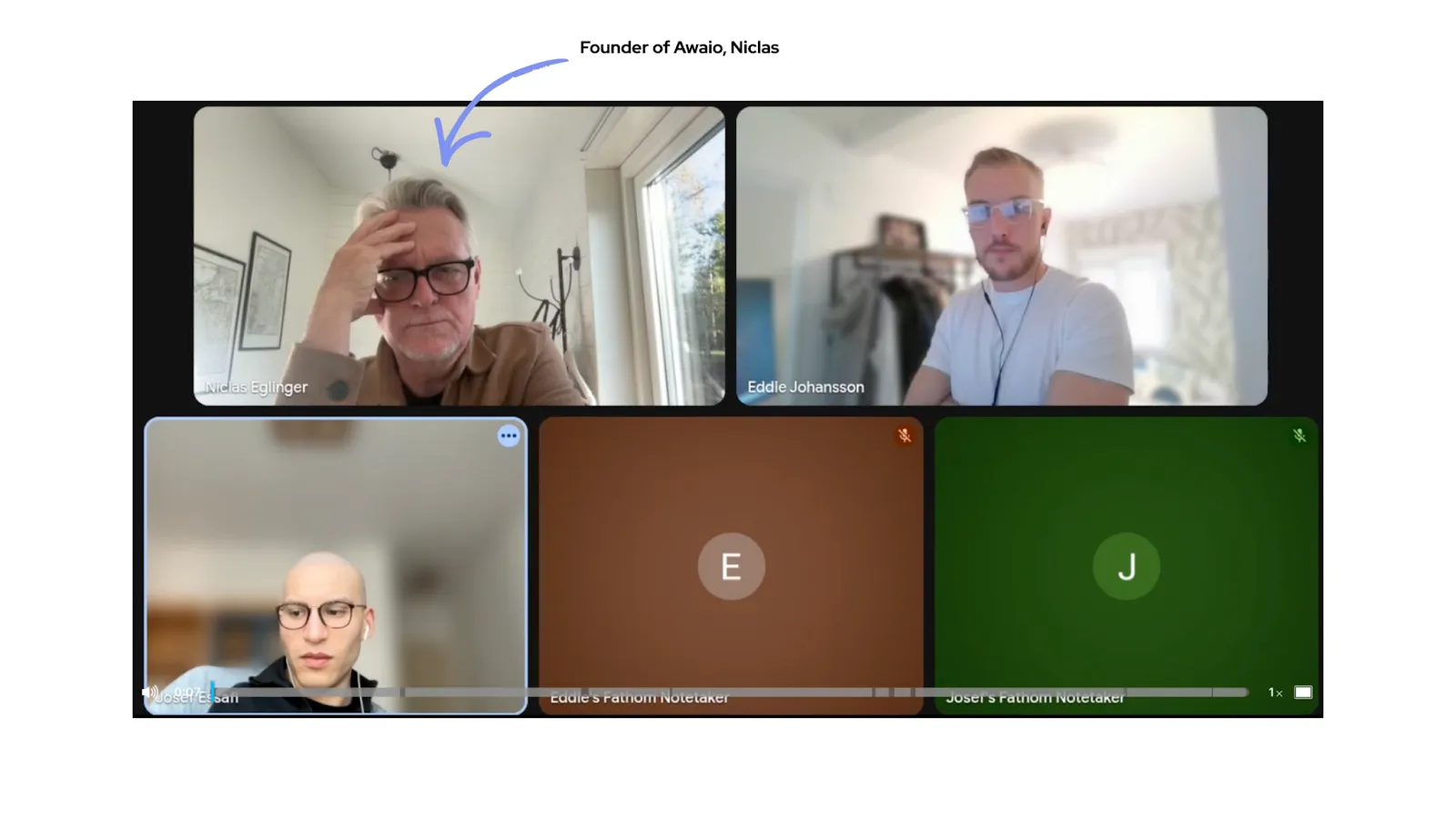
Niclas Eglinger, Awaio's CEO, put it simply:
What Gets Cited in AI Search Results
Ahrefs research on AI citations reveals clear patterns:
- Pages ranking in top 10 Google results get cited most frequently
- Direct answer formatting increases citation probability
- Comprehensive topic coverage outperforms thin content
- Brand mentions across authoritative sources improve AI recognition
Your Google rankings now serve double duty as AI citation fuel.
Content structured for featured snippets positions you for AI recommendations. Building topical authority through clustered content creates the comprehensive coverage AI systems prefer when generating answers.
The visibility compounds. Strong organic performance feeds AI visibility, which drives higher-converting traffic back to your site.
The Listicle Strategy for AI Visibility
Listicles and product roundups dominate AI citations for bottom-funnel prompts for three reasons:
- They match how AI systems parse and present information
- They provide clear comparative frameworks AI can reference when answering buyer questions
- They naturally target high-intent queries where AI traffic converts
The format "10 Best [Category] Software for [Industry]" works because it combines category relevance with use case specificity that AI platforms prioritize.
Content Structure AI Platforms Cite Most
- Clear product descriptions with specific capabilities
- Honest limitations alongside strengths
- Pricing context even when approximate
- Use case matching that helps buyers self-qualify
Pages built this way become reference material for AI-generated answers.
Why High-Intent Keywords Still Drive Clicks
High-intent keywords like "alternatives to [competitor]" and "[category] for [industry]" are less likely to trigger AI Overviews that keep users on Google without clicking through to your site (zero-click).
Even when AI Overviews appear, commercial queries still drive clicks because buyers want to:
- Validate recommendations
- Compare options directly
- Access pricing details AI summaries can't provide completely
This isn't replacing your BOFU strategy. It's reinforcing it.
The same bottom-funnel content that captures Google traffic positions you for AI citations that convert at dramatically higher rates.
The B2B Tech SEO Implementation Roadmap
Month 1: Foundation & Quick Wins
Week 1 2: Customer research & ICP deep dive
Interview three groups before touching any keyword tool:
Sales team:
- Objection patterns that come up repeatedly
- Competitor mentions in calls
- Exact phrases prospects use to describe their problems
Product team:
- Feature gaps customers cite
- Integration requests that signal buying criteria
Support and Success team:
- Why customers almost churned
- What finally made the solution click
Required output: Positioning document with 2-3 buyer personas, their specific pain points in their language, and proof points that resonate at each stage.
We wrote an entire article on this topic. You can read it here. Also, If you want to run through these questions with your team → you can access our doc with the questions we typically ask and create your own copy.
Week 3: Competitor analysis & keyword research
Map 5-10 direct competitors in SEMrush or Ahrefs. Run keyword gap analysis filtering for "Missing" and "Untapped" keywords where they rank and you don't.
Focus areas:
- Alternatives keywords under KD 25
- Comparison terms with commercial intent
- Category-for-use-case phrases matching your ICP industries
Output: 18-keyword sprint prioritized by difficulty score and intent alignment.
Week 4: Content production begins
Start with your lowest-difficulty competitor alternative keyword.
- Complete SERP analysis for format and angle gaps
- Write a comparison listicle featuring your product alongside 8-10 competitors
- Include honest positioning on strengths and limitations
Target: Publish at least 2-3 pieces in Month 1, all BOFU, interlinked to each other and relevant product pages.
Month 2 3: Build BOFU coverage
Month 2-3 shifts from foundation to execution. You're building BOFU coverage at scale now.
Content production
Target: 6 articles monthly
Content mix:
- 60-70% listicles (they capture multiple buyer searches per piece and earn AI citations more reliably)
- 30-40% competitor clusters: alternatives pages, head-to-head comparisons, pricing breakdowns
Each piece connects to keywords you validated in Month 1.
Link building
Target industry publications, SaaS review sites, and B2B marketing blogs where your ICP actually reads.
Your outreach offer matters more than volume:
- Original data
- Expert commentary
- Exclusive frameworks
Generic guest post pitches get ignored.
Goal: 5-10 high-quality backlinks (DA 35+) monthly, not 50 low-authority mentions.
Tracking setup
Implement first-touch attribution in your CRM with a custom field for "How did you first hear about us?"
Track the path:
- Traffic hits content piece
- Content piece drives conversion
- Conversion gets tracked to a specific page in GA4 (only last-click…unfortunately)
This flow answers your CEO's question from day one.
Month 4 6: Expand to MOFU & optimize
Content mix shifts
Continue: 4 BOFU pieces monthly
Add: 2 MOFU articles targeting buyers earlier in their research:
- "How to evaluate [category]"
- "Questions to ask [solution type] vendors"
These pieces capture prospects before they reach competitor searches and funnel them toward your BOFU content.
Performance optimization
Focus on positions 4-10. Pull rankings data and identify pages hovering just outside top three.
Update these with:
- Fresh examples
- Current data points
- Stronger internal links from higher-authority pages
- Re-promotion through email and social
Expand thin content that's gaining traction: If a 1,200-word piece ranks position 6, test whether 2,000 words with additional depth push it higher.
Early results tracking
Monitor weekly:
- Ranking movements
- Organic traffic specifically to BOFU pages (not site-wide)
- Demo requests with organic attribution
Refine by doubling down on what's converting and pausing what isn't.
Early signals may appear before full conversions close. Rising rankings on high-intent terms indicate pipeline impact coming even when demos haven't materialized yet.
Month 7 12: Scale & Prove ROI
You should have 30-50 BOFU articles live by now. Core competitor and category terms are starting to rank on page one.
Pipeline impact becomes measurable:
Expect 10-30 organic SQLs monthly depending on your market size and deal velocity.
For companies with average contract values above $20K, this translates to $100K-$500K+ in pipeline contribution.
When reporting to leadership, focus on the metrics executives care about:
- SQLs generated from organic
- Pipeline dollars attributed
- CAC comparison showing organic versus paid versus outbound
The conversation shifts from "is SEO working?" to "should we increase SEO investment given these unit economics?"
Additional cuts worth tracking:
- SQL-to-close rate for organic leads compared to other channels
- Time-to-close differences (organic buyers often convert faster because they've already educated themselves
Once you've proven the model, you can:
- Pursue higher keyword difficulty terms your domain authority couldn't support six months ago
- Add TOFU content (conversion infrastructure now exists to capture the demand you generate)
- Amplify with thought leadership: speaking engagements, podcast appearances, PR
- Layer in dark funnel attribution as self-reported data accumulates
SEO at this stage becomes a defensible budget line item.
You have proof it generates pipeline at sustainable CAC. The compound effects are working—each new piece builds authority that lifts existing content.
The channel earns continued investment because the numbers justify it.
Common Mistakes That Kill SEO Results
Mistake #1: Targeting keywords your buyers don't use
Your product team suggests "enterprise workflow orchestration platform." Your buyers search "project management that doesn't suck."
Internal jargon feels precise but misses actual search behavior entirely.
The fix: Pull phrases directly from sales calls and support tickets. Search those exact phrases in Ahrefs or SEMrush. If volume exists, target it.
Your vocabulary isn't your buyers' vocabulary.
Mistake #2: Writing for product users, not decision makers
The person using your software daily isn't the person signing the contract.
End users search for tutorials and troubleshooting. Decision makers search for ROI justification, vendor comparisons, and implementation timelines.
The fix: Map each keyword to the buyer who controls budget. Target their questions, not the questions of people who'll use the tool after purchase.
For example: "How to export data from [tool]" targets users. "[Tool] ROI calculator for enterprise" targets decision makers.
Mistake #3: Creating content without SERP analysis
You assume you know what format will rank. You write a detailed guide when Google rewards listicles. You build a comparison page when product pages dominate.
The fix: Search your target keyword before writing anything. Note the format ranking in positions 1-3.
Match it or have a clear differentiation strategy. Don't fight the SERP—work with it.
Mistake #4: Measuring success by rankings instead of revenue
You celebrate position improvements while pipeline stays flat. You hit page one for 15 keywords and report it as a win.
Your CEO asks how many became customers. You can't answer.
The fix: Track demos and SQLs by organic source from day one. Set up self-reported attribution in your demo form. Tie organic traffic directly to pipeline dollars in your CRM.
Rankings are leading indicators. Revenue is the only metric that justifies continued investment.
Mistake #5: Giving up too early
You expect results in 90 days when the full cycle takes longer.
Content must index, build authority, rank, earn trust, then convert buyers who research for months. Industry data shows B2B purchases involve 11.5 months of touchpoints before contracts sign.
The fix: Commit to 6-9 months minimum.
Measure leading indicators—ranking improvements, traffic to BOFU pages—while waiting for pipeline impact to materialize.
We've seen clients get their first organic demo in month 2. We've also seen clients not get meaningful pipeline contribution until month 7. The timing depends on your sales cycle, average deal size, and market dynamics.
But if you quit at month 4 because "it's not working yet," you'll never see the compound effects that make SEO worth it.
How B2B SaaS companies are driving revenue with this approach
The revenue-first framework you've read throughout this article isn't theoretical. Here's what happened when we applied this methodology to three different B2B SaaS companies.
Different markets. Unique challenges. Same fundamental approach.
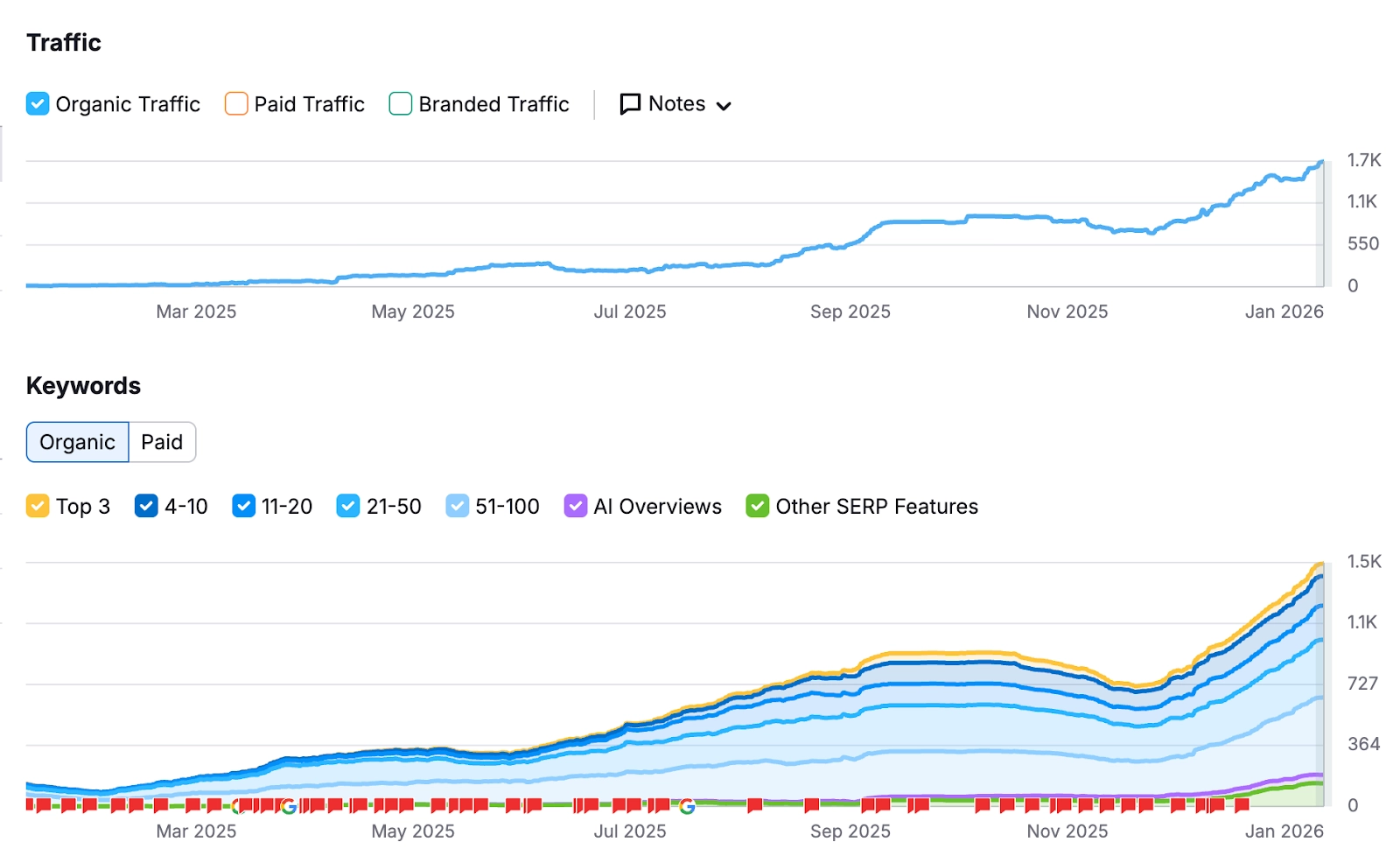
When we started working with Awaio, they had an innovative product, minimal organic visibility, and zero pipeline from search.
After 11 months:
- 171 SQLs generated from organic search
- 1,700% increase in AI-driven organic visibility
- First demo came in less than one month
Here’s what Niclas Eglinger, Awaio's CEO, had to say:
Here’s a snapshot of Awaio’s SEMrush data:
For Crono, an AI sales automation platform, the challenge was different: They are competing in one of the most saturated SaaS categories, where established domains dominate search results.
The solution was building a strategy around commercial topics with low competition. 12 months in:
- 347 SQLs generated from organic sources
- 818% increase in blog traffic
- 857% growth in AI search traffic
Alex Roggero, Crono's founder, was pleasantly surprised:
If you’re interested in seeing more case studies rooted in the strategy described in this guide -> read more success stories here.
The mindset behind a successful SEO strategy in B2B tech
The C-suite doesn't care about traffic curves. They care about CAC and revenue contribution.
The gap between "organic traffic up 40%" and "here's how much pipeline organic generated" is where most B2B Tech SEO efforts die in budget reviews.
Revenue-first SEO closes that gap:
- Start at BOFU where buyers convert, not TOFU where they browse
- Prioritize commercial intent over search volume
- Conduct customer interviews to capture actual buyer language instead of guessing at keywords
- Measure SQLs and pipeline dollars, not rankings and sessions
- Build attribution that combines GA4 tracking with self-reported source data
The exact framework described in this article is what we use to help our clients turn search into a revenue driver:
- Awaio: 171 SQLs in 11 months
- Crono: 347 SQLs with 857% AI traffic growth
- Buildbite: €275K in attributable ARR pipeline
These aren't vanity metrics. They're the numbers that justify continued investment and prove organic search drives closed deals.
Now, you have two paths forward. Book a call to assess if we are the righter partner to help build this for you. Or implement it yourself.
Either way, stop optimizing for search engines and start optimizing for revenue.
