



Most B2B SaaS marketing teams I talk to are publishing content. A blog, a content calendar, maybe a freelancer or two knocking out three posts a week. Traffic is climbing, and the monthly report looks defensible.
But a climbing traffic number and a growing pipeline aren't the same win. And most SaaS content strategies are built to solve the first one.
The content gets engineered for volume: broad keywords, top-of-funnel visibility, attracting the largest audience possible, regardless of buying intent. They're researching, learning, or just curious. And increasingly, they're getting their answers directly from AI Overviews and LLMs without ever clicking through to your site.
I've seen this pattern first-hand across more than 25 B2B SaaS companies. Same story every time.
Solid content, growing organic visits, and almost no qualified demos.
When those two numbers move in opposite directions, it's genuinely hard to defend in front of the board.
Publishing more content won't close that gap, but publishing different content will.
This is a guide on how to build your content strategy around commercial value. We’ll cover the exact content framework we’ve successfully implemented across 25+ B2B companies for building content programs that moves pipeline.
But first, let me explain why the traditional funnel order gets the sequencing completely wrong.
Most B2B SaaS content strategies are built backwards
The standard playbook is familiar because it's been repeated so many times it feels like common sense.
When traffic is the primary goal of an SEO program, every content decision flows through one lens: will this drive volume? That bias pulls teams toward the keywords with the highest search numbers, which are almost always broad, informational queries like "what is X," "how to Y," "best practices for Z."
And because those topics are generic by nature, the content needed to rank for them is cheap and easy to produce. No deep product knowledge required. Or an understanding of how buyers actually make decisions. Just a topic, a word count, and a writer. It becomes a comfort zone that's hard to argue against when the traffic chart keeps going up.
Listen, I get why it's appealing. It grows traffic reliably, generates content volume that looks productive in a report, and it scales without needing to understand the buyer or the product. Everyone wins on the surface metric.
The problem is that it never made sense as a pipeline strategy. Informational content attracts people who want answers, not people who want solutions. A VP of Marketing searching "what is marketing automation" isn't evaluating vendors, they're educating themselves, months away from a purchasing conversation.
I've seen too many sites with 100K+ in monthly traffic, the majority TOFU, converting way below what their visitor numbers would suggest.
And in 2026, this strategy makes even less sense. AI Overviews and LLMs now answer "what is X" and "how to Y" queries directly inside the search results page in two or three sentences, without the user ever clicking through to your blog.
The traffic these articles used to generate is being absorbed by AI summaries, because the content was always designed to answer a question quickly, and AI does that better. CTR erosion on informational queries has already hit 15 to 35%, and it's only moving in one direction.
And look, this isn't a criticism of the teams running these strategies. The TOFU-first model was a reasonable response to how search worked five years ago. The problem is that the industry kept building the same playbook while the conditions underneath it changed completely.
Let’s talk about what to build instead.
Quick note. If your current agency is drowning you in endless traffic reports, without being able to showcase pipeline impact—check our roundup of the best B2B SaaS SEO agencies with a revenue-first mindset.
The revenue-first content framework: what it is and why it works
Right now, there are tons of buyers actively searching for what you sell. They've already identified their problem, they know what category of solution they need, and they're comparing vendors. The BOFU-first framework is built to capture that demand — not eventually, but from day one.
The goal isn't to show up for every topic within your category. It's to show up for the prospects who are actively looking for what you offer. Buying intent is the variable that matters, not traffic volume.
What revenue-first means
I’ve managed 25+ B2B SEO campaigns, and these three keyword categories stand out for attracting visitors who actually convert into demos and trials.
Competitor keywords target buyers who are already using a solution in your category and actively looking to switch. Searches like "[Competitor] alternatives" or "[Your product] vs [Competitor]" signal that they have budget, understand the space, and are in a buying cycle right now.
Category keywords target buyers who know what type of solution they need and are building a shortlist. Searches like "best [category] software" or "[category] software for [specific use case]" show they're comparing options and close to a decision.
Pain-point keywords target buyers who have identified a problem and are actively researching ways to fix it. Searches like "how to [solve specific problem]" or "[problem] solution" may come before they know your product exists, but the intent to solve the problem is already there.
What gets deprioritised is just as important:
- "What is" definitions
- Beginner educational content
- Generic best practice articles
Simply because these attract researchers. And that distinction is what separates a revenue-first content strategy from one that generates traffic without pipeline.
The strategy we implemented for Awaio is a great example of the impact a well-executed, content strategy around buying intent can have.
.webp)
Why it converts where traditional strategies don't
The difference between traffic and demos is almost always search intent.
Take two keywords.
- "What is CRM" gets around 80,000 searches per month.
- "salesforce alternatives for small business" gets around 300.
By every conventional content metric, the first keyword wins — but it loses on every revenue metric that actually matters.
The person searching "Salesforce alternatives" is already inside a buying decision. They have a CRM. They're unhappy with it. They want to replace it today. At a 5–8% conversion rate, that 300-search keyword will drive more qualified pipeline than 80,000 monthly visits from people who just wanted a quick definition.
Our own data backs this up. Across 25 B2B SaaS clients, certain keyword types converted at 15–20x the rate of others.

You should never dismiss a keyword just because the search volume is low. A handful of monthly searches from buyers already in evaluation mode will outperform tens of thousands of visits from people who were never going to buy.
Building your first revenue-first content strategy
At Exceed, we structure client engagements around 3-month content sprints, publishing 4-6 pieces per month.
The reason the sprint model works is that three months is long enough to start seeing what's ranking and what's converting, but short enough to course-correct before you've spent six months going in the wrong direction. You're planning ahead without locking yourself into a strategy that data might tell you to adjust.
The 4-6 pieces per month cadence sits in a sweet spot for the same reason. It's enough volume to build authority and start generating results faster than a two-post-a-month approach, but not so much that quality takes a hit. In B2B SaaS SEO, one well-researched commercial piece will outperform five generic ones every time.
Start with the content mix, not the calendar
Most content teams plan by volume: how many posts per month, how many weeks ahead the calendar runs, how many writers are on the roster. The sprint structure here plans by a different question: which content is most likely to generate a demo this quarter?
To make this concrete, let's use an example. Assume you offer CRM software for law firms. Your biggest competitor is Clio. The main pain points you solve are inefficient sales processes and low profitability.
Here's what the first 90-day content sprint looks like:

Fifteen articles total across the quarter, with 67% concentration on highly commercial keywords, and the average keyword difficulty of 12.
The topical relationship between these keywords is as important as the keywords themselves. A topical cluster is a group of articles covering the same subject from different angles. Building them serves two purposes: it signals to Google that you genuinely understand the topic, which improves rankings across the entire cluster, and it means you show up regardless of how a prospect phrases their search that day.
The competitor cluster is a great example of this. It is not one comparison article. It is five pieces targeting the same buyer at different moments in the same evaluation:
- An alternatives page ("best [Competitor] alternatives")
- A head-to-head comparison ("[Competitor 1] vs [Competitor 2]")
- Three more articles covering the decision criteria buyers use at the final stage (pricing, reviews, features)
One buyer. One competitor. Five entry points. Each piece catches the same person, depending on exactly how they phrased their search that day.
As you wrap up the 3-month sprint, you have built content that attracts prospects:
- Looking for solutions in your category
- Evaluating alternatives to your main competitor
- Trying to fix a problem you help solve
This sequencing is what connects SEO that drives pipeline to closed revenue, rather than producing traffic that never converts.
Match keyword difficulty to your domain authority
The fastest way to find out what's working is to rank quickly and see what converts. That means prioritising keywords with strong buying intent and low competition — regardless of how established your domain is.
The lower the competition, the faster you rank. The faster you rank, the sooner you start collecting real data on what's actually driving demos.
Going back to the CRM for law firms example. The average keyword difficulty across the entire 90-day sprint was 12 out of 100. Simply because long-tail commercial keywords naturally tend to have lower competition. Fewer sites are targeting "best CRM for personal injury law firms" than "best CRM software."
We've seen this play out across clients consistently. For InviteDesk, with a DA of 23, we targeted a competitor alternatives keyword with extremely low competition, ranked in the top five within 48 hours, and booked a demo 22 days later from a keyword drawing just 60 monthly searches. By traffic standards, that's a nothing result. From a pipeline standpoint, it's exactly what the strategy is designed to produce.
As your domain authority grows, you get more room to go after harder keywords. But the starting principle stays the same: low competition, high intent, fast feedback.
The research step everyone skips: talking to your sales team
Most marketing teams build their content strategy in isolation. They pick keywords, map topics, and start writing — without ever sitting down with the people who talk to prospects every single day. The result is content that sounds right internally but misses how buyers actually describe their problems.
Your sales team, your customer success team, your support team — these people spend their entire days inside conversations with the exact buyers you're trying to attract. They know which objections come up on every call, which competitors prospects are switching from, and the exact phrases buyers use to describe their pain. That intelligence doesn't live in SEMrush. It lives in those conversations, and most marketing teams never tap into it.
Talk to your customer-facing teams, from sales to customer success
In these conversations, start by identifying your best customers — the ones with the highest LTV, who pay the most and stay the longest. Before a single keyword goes into the content plan, you want to understand what those customers have in common. That shared profile becomes the foundation everything else is built on.
Once you've defined that profile, you dig deeper into it from two angles.
Talk to sales to understand what drove those buyers to seek out a solution in the first place. Some example questions to ask:
- Which pain points triggered urgency?
- Who did they compare you against, and why did they choose you over the alternatives?
- What had they already tried before finding you?
Sales teams hold the answers to all of these questions. They just rarely get asked.
Then, chat with your customer success and support teams to understand what happened after the sale.
- What did those customers actually achieve?
- How did solving that initial problem change their business?
- What specific features or workflows helped them achieve their desired outcome?
This is where you find the transformation story — the before and after that makes content resonate with prospects who are facing the same situation.
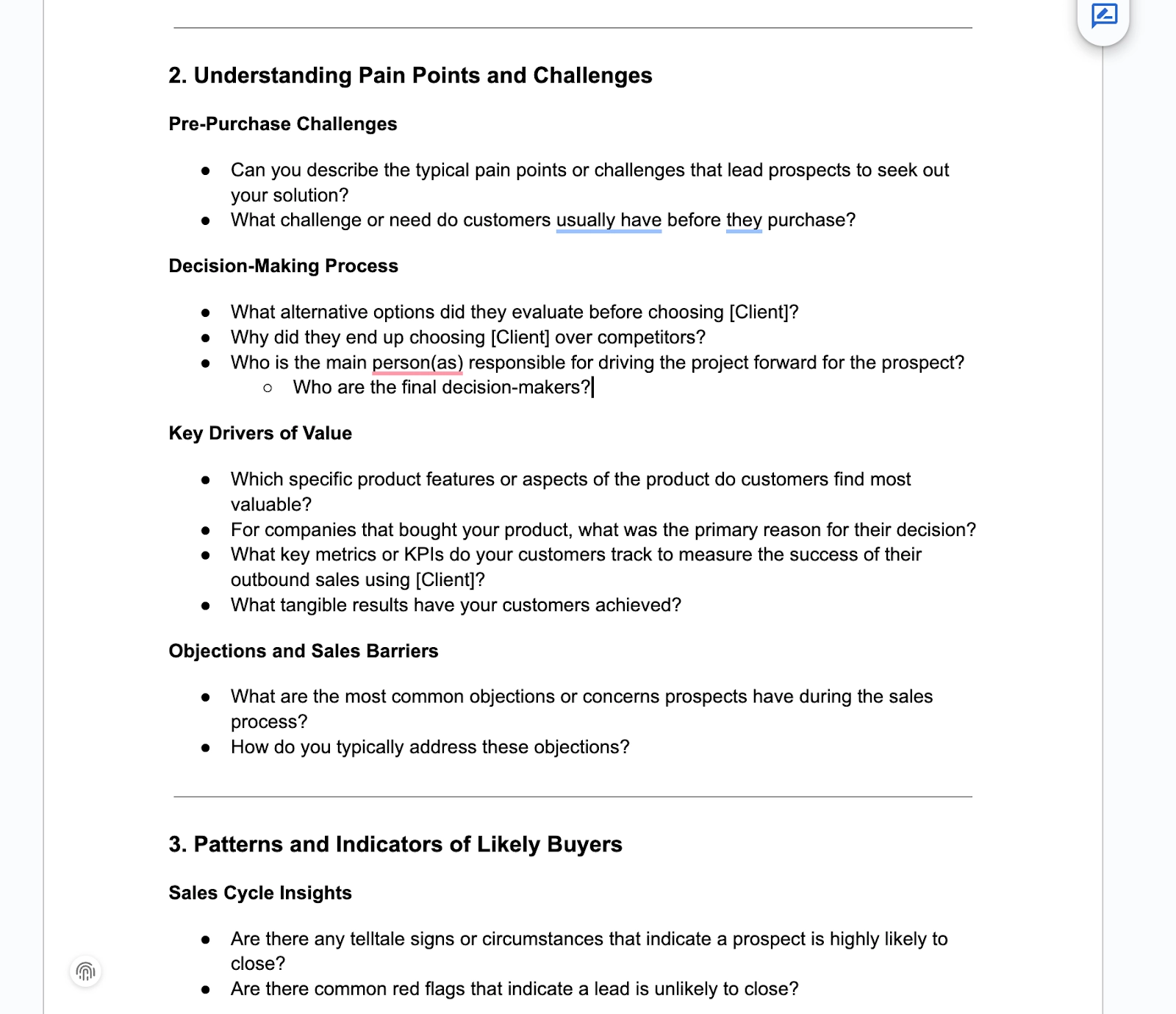
We have a proven questionnaire for running these calls. You can access the questions here and create your own copy.
By the end of these conversations, you have a clear picture of who you want to attract, what problems they face, and the specific impact of solving those problems with your solution. These insights will not only help you target the most relevant topics, but also strengthen your actual content.
How these insights shape your content strategy
The core value of these conversations is that the answers map directly to your content priorities.
If your sales team consistently mentions three competitors that come up in every final evaluation, those are your first three competitor comparison pages. Not because a keyword tool flagged them, but because your own sales data tells you that's where buyers are making their decision.
If the majority of your highest LTV customers came to you with the same underlying problem, that's your signal for which pain-point content to prioritise. You're not guessing at what resonates. Instead, you're writing about the exact situation your best customers were in before they found you.
The same logic applies to language. Buyers rarely describe their problems using the clean category terms that show up in keyword tools. They use specific, often messy language that only surfaces in sales calls and support tickets. When your content reflects that language back at them, it stops feeling like marketing and starts feeling like someone who actually understands their problem.
What good BOFU content looks like
Getting the strategy right is step one. The next question is always: what does this look like when you sit down to write it?
It's worth repeating that the quality of your content is directly tied to the quality of your customer research. The insights from those sales and success conversations aren't just useful for keyword selection. They're what separates generic content from content that makes a prospect think "this is exactly my situation."
With that foundation in place, three things tend to separate content that converts from content that just ranks.
1. Write how your buyers talk, not how your product team writes.
The biggest problem in B2B SaaS content is overly complex language. "We leverage cutting-edge automation to synergize workflows and optimise high-value client engagement" might feel authoritative internally. To a buyer, it says nothing.
The same idea written without any fluff: "Keep track of all high-value deals without spreadsheets so you never miss a follow-up."
Your audience is knowledgeable, and they don't need to be impressed with jargon. The art is unpacking complex subjects with clear, simple language that reflects how they actually think about their problem.
2. Replace vague claims with specific ones.
"Our CRM streamlines relationship management" could describe any CRM on the market. It gives the reader nothing to hold onto.
Compare that to: "Track referral sources, stakeholder contacts, and deal milestones in one place instead of three spreadsheets."
This level of specificity is what makes a buyer think "these people actually understand my problem." Vague claims just blend into every other product page they've read that day.
3. Make your content impossible to replicate.
The third thing has nothing to do with writing. It's originality.
Embed your own data, pull quotes from subject matter experts, include real reviews from G2 or Capterra when writing competitor comparisons. Do whatever you can to add a perspective that nobody else can copy.
How to know if it's working (and what to stop measuring)
Stop reporting traffic milestones to your CEO. Stop sending keyword ranking updates to the board. Page views, time on site, and organic sessions are not proof that content is generating revenue. They are proof that content exists.
The metrics that really matters to your leadership team:
- Demo requests by channel
- SQLs generated from organic
- Pipeline value in dollars
- Close rate for organic leads versus other channels
- CAC for SEO compared to paid or outbound
When you can report those five numbers with confidence, the traffic chart becomes irrelevant.
And attribution does not need to be complicated. Here’s a simpler way of measuring success:
- Add a single "How did you first hear about us?" field to your demo booking form
- Track GA4 last click to capture the final touchpoint before conversion
- Reconcile both against your CRM pipeline at the end of each month
That three-step process surfaces more actionable signals than any multi-touch attribution model built on incomplete data.
Simple attribution wins because it gets used. Complex models get built once and then quietly ignored when the numbers are inconvenient.
The conversation ender with the CEO looks like this: "Organic generated 18 demos this quarter at a CPL of €200, closing at 31%." That sentence requires no chart, no ranking report, and no explanation of why traffic is up while demos were flat six months ago. It answers the question the board is actually asking.
If your current reporting cannot produce such a trend, the measurement infrastructure is the first thing to fix, before the content calendar, before the keyword research, before the agency conversation. Measuring the right things is what makes everything else visible.
Conclusion
The problem most SaaS marketing teams face is that the content they're producing was never designed to attract buyers in the first place.
The framework covered here is designed to fix just that, and it comes down to three things:
- Start with the keywords buyers type when they're already evaluating solutions
- Talk to your sales and customer success teams to understand your best customers
- Measure the metrics that actually answer your CEO's question around content performance
The content you publish next month should be doing different work than the content you published last month. That's the only shift that matters.
