
.webp)
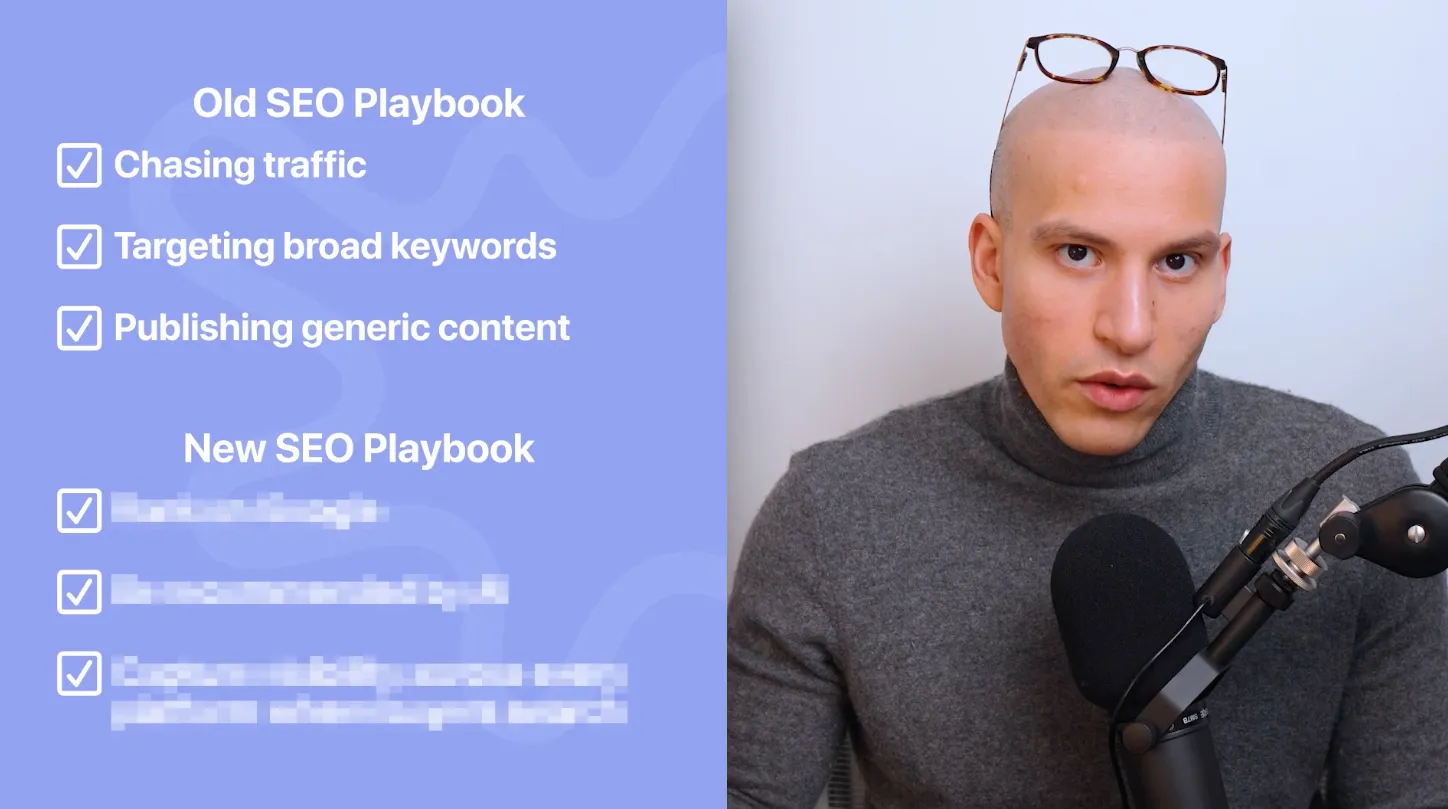

Prefer to watch? The video covers everything in this post.
Last year, we drove over €2 million in qualified pipeline for our B2B SaaS clients through organic search. Some parts of that same playbook is already outdated.
I'm watching three fundamental shifts reshape how buyers discover and evaluate B2B software. The companies adapting now will capture market share while their competitors wonder why traffic is up but demos are flat.
60% of Google searches now end without a click. ChatGPT is the fourth most-visited website globally with 5 billion monthly visits. And AI-generated content is flooding every category, making genuine expertise the only way to stand out.
If you're still optimizing purely for Google rankings, targeting high-volume keywords, and measuring success by traffic—you're playing the wrong game.
Shift #1: Your Buyers Aren't Just Searching on Google Anymore
Google is still dominant. But 60% of searches now end without anyone clicking through to a website—up from 77% on mobile. Featured snippets and AI Overviews answer questions directly on the results page.
You're competing for 40% of the clicks you used to get from the same search volume.
Meanwhile, ChatGPT grew to 5 billion monthly visits. 35% of Gen Z now use AI chatbots alongside traditional search. AI search traffic increased 500% last year.
Your prospects still use Google as their primary tool. But they're also asking ChatGPT for recommendations, using Perplexity for research, and getting product suggestions from AI before they ever click a website.
When someone asks "What's the best CRM for startups?" in ChatGPT, does it recommend you or your competitor?
The old model was linear: rank on Google, get clicks, convert leads. The new model requires visibility everywhere buyers look—Google rankings plus AI recommendations.
How to capture multi-platform visibility
Structure content for both algorithms. Clear organization, authoritative information, and well-formatted answers work for traditional search rankings and AI citations. Comparison pages like "HubSpot vs Salesforce" or alternative roundups like "Best Asana alternatives for enterprise teams" rank well on Google and get referenced by AI systems because they're comprehensive and genuinely useful.
Bottom-of-funnel content is particularly effective here—it has the structure and specificity that both Google and AI prioritize.
Build authority signals that AI systems recognize. Backlinks from industry publications, G2 reviews, and mentions in third-party media teach AI that you're a credible source worth recommending. This isn't just for Google anymore—AI systems check whether brands appear on trusted sites before citing them.
Monitor visibility across platforms. Track Google rankings like always, but also check whether you appear when prospects ask AI about your category. The baseline expectation in 2026 is winning on both fronts.
Shift #2: Traffic Is a Vanity Metric (And Always Was)
100,000 monthly visitors means nothing if they don't convert. Yet most B2B SaaS companies still optimize for traffic volume instead of revenue.
I see this pattern constantly: "Our traffic is up 50% but we're not getting more demos."
They're ranking for "what is marketing automation"—attracting students, job seekers, and people 18 months away from buying. Their competitor ranks for "marketing automation for B2B SaaS" with one-tenth the traffic but 10x the conversion rate.
When we analyzed conversion data across 50+ B2B SaaS campaigns, we found a 17x difference in conversion rates between keyword types. "Project management best practices" converts at 0.1%. "Asana alternative for enterprise" converts at 7.8%.
Same product. Same website. Completely different outcomes based solely on which keywords you target.
50 visitors from bottom-funnel keywords beat 5,000 visitors from generic awareness content. Every single time. Because traffic doesn't pay the bills—revenue does.
The bottom-up keyword strategy
Stop measuring success by traffic. Track demos booked, trials started, SQLs generated, and revenue attributed to organic.
Then flip your keyword strategy to match. Start at the bottom of the funnel where purchase decisions happen, not the top where researchers browse.
Target solution-specific searches with clear buyer intent: "best accounting software for freelancers," "CRM for real estate agencies," "HR software for remote teams." Lower volume, dramatically higher intent.
Build comparison content for prospects actively evaluating options: "Slack vs Microsoft Teams," "HubSpot alternatives for agencies," "Asana vs Monday for engineering teams." These are the searches people do one step away from signing a contract.
The biggest insight here: your sales team already knows which searches your best customers actually do. Not talking to sales is one of the biggest marketing blind spots in B2B. They hear the exact language prospects use in demos, which competitors surface in late-stage conversations, and why deals close or fall through.
Use that intelligence to shape your keyword strategy instead of chasing high-volume terms that look good in reports but never convert.
Shift #3: Authority Is the Only Moat Against AI Content
Generic AI-generated content is flooding every category. Millions of pages. The only way to stand out—on Google, on AI platforms, everywhere—is genuine expertise.
Google's December 2025 core update rewarded niche blogs written by real people with lived experience over faceless corporate sites stuffed with AI content. AI systems follow similar logic. ChatGPT, Perplexity, and Claude prioritize content from trusted sources, checking whether it's written by an expert, whether the site has authoritative backlinks, and whether the brand appears on credible third-party sites.
E-E-A-T (Experience, Expertise, Authoritativeness, Trustworthiness) isn't a buzzword anymore—it's the filter determining who ranks and who gets cited.
Content without real expertise gets filtered out. And here's what makes this interesting: bottom-of-funnel content inherently requires expertise. You can't fake a useful "HubSpot vs Salesforce" comparison. You can't AI-generate a "best accounting software for construction companies" page that actually helps buyers without real customer insights, product knowledge, and use cases.
That's what makes it authoritative. That's exactly why it works for both Google rankings and AI citations.
How we build authority at Exceed
We do subject matter expert interviews for almost every piece of content. Product teams, sales reps, customers—getting quotes, data, and perspectives only our clients have access to.
Customer interviews are the backbone of effective bottom-funnel SEO. We use qualitative coding methods to extract patterns from these conversations that inform content strategy.
We focus on backlinks from genuinely authoritative, relevant sources—real industry publications, not garbage directory links. Strong G2 and Capterra profiles. Media coverage in the client's space.
And we create content only our clients can create: unique research, original frameworks, customer case studies with measurable results. This is how you differentiate when everyone has access to the same AI tools.
Authority is your moat. Without it, you're competing on the same playing field as everyone else publishing AI-generated content.
The Competitive Advantage Goes to Those Who Move First
Companies adapting to these three shifts now will capture market share while competitors keep chasing the wrong metrics.
The old playbook—chase traffic, target broad keywords, publish generic content—is delivering declining returns. The opportunity is significant, but only for companies willing to fundamentally change their approach.
Most companies understand what's changing. Actually building a strategy that accounts for multi-platform visibility, bottom-funnel prioritization, and genuine authority? That's where they get stuck.
If you're a B2B SaaS company doing at least €500K ARR and want an SEO strategy that drives pipeline instead of vanity metrics, book a call with me. I'll audit your current approach, show you where you're leaving revenue on the table, and map out what a bottom-funnel strategy would look like for your business.
No pitch. Just a real conversation about whether this makes sense.
For more on what separates effective B2B SaaS SEO from generic approaches, see our guides on B2B SaaS SEO and B2B tech SEO. If you're evaluating agencies, here's our breakdown of the best B2B SaaS SEO agencies and red flags to watch for when choosing an agency.
About Exceed SEO
We focus on B2B SaaS SEO that drives pipeline growth, not vanity metrics. Our clients include Willo, InviteDesk, Buildbite, Crono, and Pelotech.
Our approach: bottom-funnel content prioritization, sales team interviews that inform strategy, active testing and optimization, and 30-day rolling contracts.
See how we helped Awaio generate 171 SQLs in 11 months.
If this makes sense for your business, reach out.
